From Idea to Brand: 5 Simple Steps to Build a Marketing Strategy
Published Feb 26, 2026
A marketing strategy is not a 40-page slide deck. It is a small number of clear decisions about who you serve, what you promise them, how you reach them, and how you measure success. This guide walks through the five simple steps to build a marketing strategy that works for a founder or small team in 2026: positioning, audience, channels, measurement, and iteration. Each step takes an afternoon; the whole strategy takes a week to draft and 90 days to test.
What Is a Marketing Strategy?
A marketing strategy is the collection of "yes" and "no" decisions that shape where your business invests attention and budget to grow. Strategy is not a document; it is the choices reflected in your team's calendar. Businesses without strategy tend to work reactively, chasing every opportunity; businesses with strategy work deliberately, saying no to opportunities that do not fit.

Most stalled startups do not lack a strategy document. They lack a strategy discipline. Everyone knows what to do; nobody has decided what not to do. These five steps produce specific "no" decisions in the process of committing to specific "yes" decisions.
Step 1: Define Your Positioning
Positioning is the specific mental slot your business occupies relative to alternatives. Sharp positioning attracts the right customers and repels the wrong ones. Write your positioning as a one-line statement: "We help X do Y so they can Z."
Test the statement with three real customers. If they can repeat it back in their own words, it is sharp enough. If they cannot, refine it. Weak positioning is the root cause of most conversion problems and most stalled marketing efforts. Fix this first. The move takes an afternoon; the impact compounds for years.
Step 2: Identify Your Audience
Not every buyer is your buyer. Your audience is the specific slice of the market that will get the most value from your product and will pay for it. Define your ideal customer profile (ICP) with specificity: company size, industry, role of the buyer, budget range, current alternatives they use.
For B2B, look at your top 20 percent of customers by revenue or retention. What do they share? Build the ICP from that pattern. Then rewrite every piece of marketing (ads, landing pages, cold outreach, content) with that specific audience in mind. Reply rates and conversion typically improve 40 to 80 percent within 30 days.
Step 3: Choose Your Channels
You cannot dominate every channel. You can dominate one. The businesses that grow fastest concentrate 60 percent of their budget and attention on their best channel for 12 to 18 months before adding a second.

Pick your primary channel based on where your ICP already spends time and where your positioning translates most powerfully. For B2B SaaS in 2026: LinkedIn, search, content, and partner-led growth. See our affiliate program guide for the highest-return partner channel move. For local businesses: Google Business Profile plus one social platform. For ecommerce: search plus Meta plus email.
Step 4: Set Up Measurement
A strategy without measurement is aspiration. Define three metrics before you spend a dollar on marketing: a primary metric (usually pipeline or customer acquisition), a leading indicator (something that predicts the primary metric 30 to 60 days early), and a guardrail (something you must not damage while pursuing growth).
Tools: Google Analytics 4 (free) or Fathom Analytics ($15/mo) for site behavior. Your CRM for pipeline. A simple spreadsheet for weekly review of the three metrics. Reviewing metrics weekly for the first 90 days is the single biggest predictor of whether the strategy will produce results.
Step 5: Iterate Every 90 Days
No strategy survives contact with the market unchanged. Every 90 days, review the three metrics. If the primary metric is moving, double down. If not, diagnose why: is positioning off, audience wrong, channel wrong, or execution weak? Fix the specific gap.
The businesses that grow fastest are not the ones with the best initial strategy. They are the ones with the fastest iteration loop. A team that runs four honest 90-day cycles in a year consistently outperforms a team that plans for 12 months and delivers no reviews.
Some Helpful Tools and Visuals for Each Step
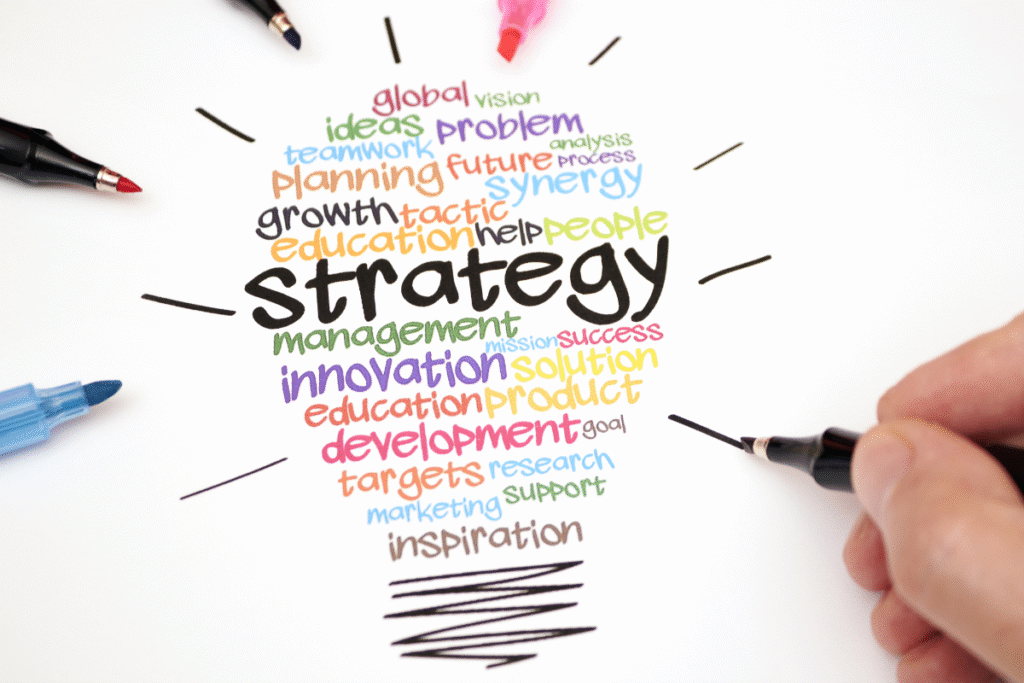
For positioning: April Dunford's "Obviously Awesome" framework is the practical standard. For audience: Clay or Apollo for ICP research and enrichment. For channels: HubSpot free CRM plus one channel-specific tool. For measurement: Google Analytics 4 plus a Google Sheets scorecard. For iteration: a recurring monthly review meeting with your team, with the three metrics on the agenda.
How to Get the Strategy Down to One Page
Every strategy should fit on one page. If it does not, it is too complex to execute. Your one-page strategy: positioning statement (one sentence), ICP definition (one paragraph), primary channel (one line), three metrics (three lines), 90-day priority (one sentence). Print this. Post it where the team sees it daily. Review weekly.
How to Choose the Best Channel for Your Business
Channel selection is often where founders get stuck. A useful decision framework: (1) where does your ICP already spend time researching solutions in your category? (2) which channel matches your positioning best (visual channels for visual brands, text channels for thought-leadership brands)? (3) which channel matches your team's realistic execution capacity? Pick the channel that answers "yes" to all three.
For B2B SaaS in 2026: LinkedIn plus search is the default answer for growth-stage teams. For local service businesses: Google Business Profile plus one social channel. For consumer ecommerce: paid social plus email. Match your channel choice to your stage rather than to what looks trendy.
A Real Example of a Marketing Strategy Applied
A B2B SaaS founder at $500K ARR built her strategy in one week using these five steps. Positioning: "We help mid-market ecommerce brands reduce cart abandonment by 30 percent so they can hit growth targets without adding paid spend." ICP: ecommerce brands doing $10M to $100M ARR on Shopify Plus. Primary channel: LinkedIn plus targeted content. Metrics: qualified demos booked, cost per demo, close rate. 90-day priority: publish 12 case studies with named customers.
Twelve months later, ARR grew from $500K to $2.1M. The strategy did not change. The consistency of applying it did.
Common Mistakes When Building a Marketing Strategy
Skipping positioning. Every downstream decision is weaker without sharp positioning.
Broad audience definition. "Growing businesses" is not an audience; "50 to 200 person B2B SaaS companies with existing paid programs" is.
Spreading across channels. One dominated channel beats five mediocre channels.
Skipping measurement. You cannot improve what you do not measure.
Building a strategy and never revisiting it. Strategy is a living document reviewed quarterly.
Frequently Asked Questions
How long does it take to build a marketing strategy?
The draft takes a week. The first 90-day test cycle produces enough data to refine. Full strategy maturity typically takes 12 months of consistent iteration. Do not wait to be "ready"; start with a rough version and improve every quarter.
Do I need a strategy if I am pre-revenue?
Yes, but a lighter version. Focus on positioning and audience. Channels and measurement matter more once you have customers to learn from. Product-market fit conversation should come before major channel investment.
Can I build a marketing strategy without hiring anyone?
Absolutely. Every step in this guide can be done by a founder alone in 5 to 10 hours per week. Hiring becomes valuable once execution volume exceeds the founder's capacity, typically at $500K to $2M ARR for B2B SaaS.
How is a marketing strategy different from a marketing plan?
Strategy is the "what" and "why" (positioning, audience, channels). Plan is the "how" and "when" (specific campaigns, content calendar, budget allocation). Strategy should be stable for 12 months; plans should be revised quarterly.
What is the biggest mistake with marketing strategy?
Building a strategy that stays in a slide deck rather than living in the team's weekly calendar. Strategy that does not shape daily decisions is not strategy; it is a wish.
Should our marketing strategy change if the market shifts?
The tactics should change; the core strategy usually should not. If positioning, audience, and channel choices need to change every quarter, the strategy was never sharp enough to begin with. Stable strategy, adaptive tactics, is the right posture.
One useful frame: strategy is what you say no to. If your one-page strategy does not clearly rule out at least three activities you could be doing but choose not to, it is probably not sharp enough. Great strategies are as clear about the "no" list as the "yes" list.
A marketing strategy is not a mystical document produced by consultants. It is a small number of clear decisions made deliberately, written on one page, and reviewed weekly. Start with positioning tomorrow, add audience next week, pick your channel by month one, instrument measurement by month two, and iterate every 90 days from there. That is the entire practice, and it consistently produces businesses that grow steadily while peers stall.
Ready to build your marketing strategy?
Tell us where you are today across the five steps. We will help you fill the gaps and build a one-page strategy you can act on this quarter.
Affiliate Disclosure
This article may contain affiliate links or sponsored content. If you click on a link and make a purchase, we may earn a commission at no additional cost to you. We only recommend products and services we believe provide genuine value to our readers.
Full Disclosure: As an affiliate partner, we participate in various affiliate programs and may receive compensation when you purchase through our links. This helps support our content creation and keeps our resources free for the community.